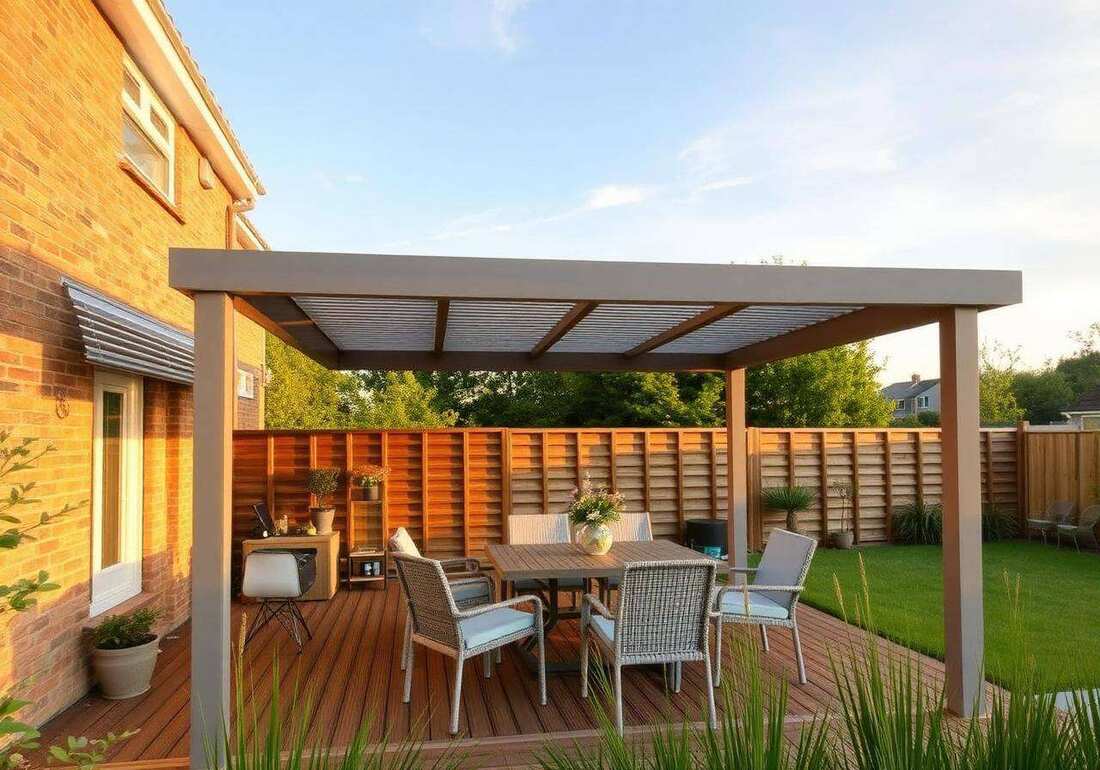
Neither a gazebo nor a pergola is sauna-special. Both offer design options to help you focus your outdoor space and have become common enough in gardens in the UK that a fault of judgement is overlooked. Both look alike when seen in a store and the average outdoor design objective is very similar. And while the main purpose of the two could be the same, practical differences become clear when once you need to decide what you want your outdoor space to accomplish.
Cedar vs. Metal: What is the Right Material for your Pergola
A pergola contains an open space division, usually a slatted or open rooftop, or one that is partly overgrown with climbers. A customary characteristic of of a pergola is its enclosure. They serve to define outdoor space, while remaining open to your garden or your surroundings.
The most popular traditional pergola is one that is constructed from wood or metal, with a slatted or arching roof beam, and are becoming the norm when you consider the flexibility of control that you get over a combination of radiant and rain coverage by a roof of their design on a slatted horizontal plane that can be opened and closed.
They are most appropriate for gardens where an open to the larger outdoor space defined area is desired to be a shade-sustained room that can also house or support the hanging of an outdoor light as well as a dining or seating area.
Distinguishing Features of a Gazebo
A gazebo is a structure with a solid roof and (depending on design) partially closed sides. Gazebo roof sections protect from the rain and walls design a ‘room’ feel within the garden as opposed to a garden accessory.
Permanent gazebos are usually timber, metal, or composite, pitched roof, square or octagonal, structures. Gazebos are larger, more architectural, garden elements than pergolas. Pergolas are roofless, beam garden structures.
Temporary and pop-up gazebos are folding-frame, canopy, structures for garden events. These are distinguishable from permanent garden structures and are not relevant to this discussion.
Differentials In Function
UK walls give pergolas shade, and rain protection, if a roof is fitted. There is little protection from the rain with an open beam roof and climbing plants. This is more an outdoor than a garden structure.
A gazebo has a solid roof. This keeps the interior space dry, but the sheltering walls design an enclosed feel, isolating the garden.
Louvred aluminium pergolas are the most practical option for year-round use in the UK. Unlike wood pergolas, which have more gaps for the weather, aluminium pergolas are more weather resistant. Therefore, a louvred pergola can give you the most control in severe weather. The cost for most aluminium louvred pergolas is around £2,500–£3,500.
Position and Planning
When placed within a given size, both of these structures are usually considered permitted due to their status as a development for domestic gardens. If within two meters of a property boundary fence, one of these structures can be a maximum height of 2.5 meters. Beyond that, a dual-pitched roof can usually be a maximum height of 4 meters. Of course, the development restrictions of listed buildings, conservation areas, and relatively large structures with respect to their garden-sized structures are exceptions to these rules.
Because of the gazebo’s more fully enclosed structure, position is more critical for a gazebo than for a pergola. For the gazebo, too close of a position to the house can make it feel as if it is blocking the view of the garden, while at the far end of the garden, it can make it feel as if it is disconnected. For the gazebo, it seems the best is a mid-garden position or the position as a transition between the planted area and the lawn.
In terms of flexibility, positioning a pergola is more so than a gazebo, because a pergola is more of an open structure. Because a pergola is more an open structure, a pergola can be placed in a number of positions, such as the boundary fence, the middle of the garden, or the house wall of the garden, without taking over the garden space.
Cost
For a self-built timber pergola kit, you can expect to pay around £300-£500 for a 3x3m frame. Prices for hardwood or pressure-treated timber pergolas start from around £1,500-£3,000 for a fully constructed and installed model.
The premium louvred aluminium options cost around £2,500 for a smaller unit which can easily increase beyond £6,000-8,000 for a large custom unit.
For timber gazebos, you are also looking at a similar starting cost of £1,500-£2,500 for a mid-sized unit. The costs also increase for larger and more luxuriously appointed units.